
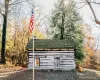
The Drake Log Cabin is an 18' x 22' rectangular-shaped, one-room log cabin. Its hand-hewn shaped logs alternate with layers of mud mortar. A split-shingle-covered, gable roof with an interior end stone chimney tops the IH story cabin.
Historic Houses

Located in Meadville, the Baldwin-Reynolds House was once home to Supreme Court Justice Henry Baldwin (1780-1840) and, at other times, two of Meadville's mayors. Purchased by the Meadville Historical Society, the house now includes an ice house, tannery, garden, and spring-fed pond.
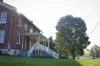
Abel Colley was a son of Peter Colley who had an early tavern (Peter Colley Tavern) on the National Road nearly two miles northwest of this building in Redstone Township. Reputedly, Abel Calley's tavern-keeping enabled him to accumulate a fortune.
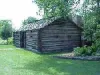
Have you ever wondered where the first colonial settlement in northwest Pennsylvania was located? Well, look no further than Meadville. In 1787, at the age of 36, David Mead and his brother, John, went scouting the northwestern Pennsylvania wilderness for a new location to settle.
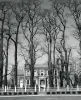
Born in Northumberland County on December 15, 1792, to Irish immigrants John and Mary Fullerton Irvine, Guy C. Irvine arrived in Brokenstraw Township in 1817.
Most of us are familiar with the story of Johnny Appleseed—the barefoot, bearded, coffee-sack-and-tin-pan-hat-wearing wanderer who traversed the American wilderness in the early 1800s, casting seeds and giving rise to umpteen apple trees across the Midwest.

Providence Meeting House memorializes this region's Quaker pioneers and early settlers. The highly respected Society of Friends has been uniquely identified with our state since the day of its founder, William Penn.
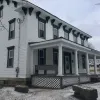
On April 22, 1976, the Marshall House became the first building in Armstrong County to be added to the Pennsylvania Inventory of Historic Places. In May 1976, it was also placed on the National Register of Historic Places.